Durable Treatment Tables for Estheticians: 2026 Guide
Table of Contents
- What Makes a Treatment Table Durable Enough for Daily Spa Use
- Electric vs. Hydraulic vs. Portable: Choosing Your Table Type
- Heavy Duty Facial Beds: When You Need Extra Load Support
- Treatment Table Weight Capacity Requirements Explained
- Upholstery, Foam, and Frame: Materials That Last
- Spa Equipment Maintenance Tips for Long Table Life
- Ergonomics and Space: Setting Up Your Treatment Room
- Frequently Asked Questions
Last Updated: October 1, 2026
What Makes a Treatment Table Durable Enough for Daily Spa Use
Durability in a professional treatment table comes down to three things: a steel frame, high-density foam that recovers its shape, and upholstery that resists oils and disinfectants. Miss one and you'll replace furniture long before you planned to.
Electric vs. Hydraulic vs. Portable: Choosing Your Table Type
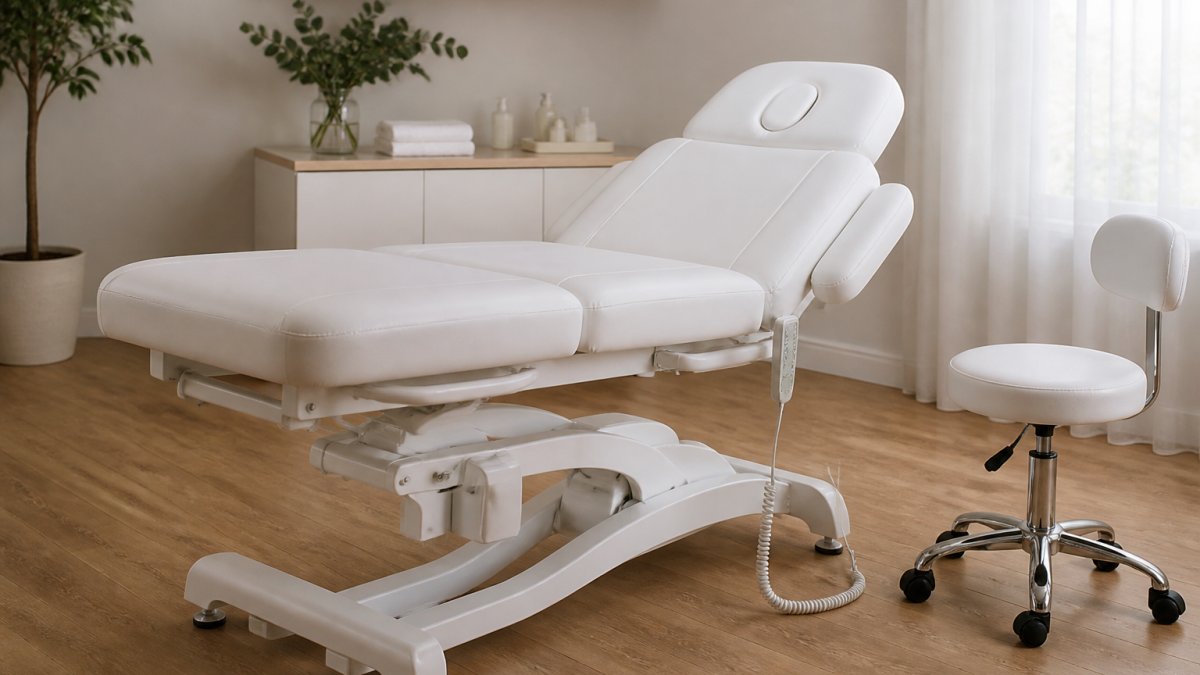
Electric tables use a motorized actuator controlled by foot pedal or hand control. Hydraulic tables rely on a pump and cylinder. Portable tables fold flat and use manual height pins.
Each type suits a different practice:
| Table Type | Power Source | Best For | Main Trade-Off |
|---|---|---|---|
| Electric | Motorized actuator | High-volume med spas | Higher upfront cost |
| Hydraulic | Foot pump | Solo practitioners, no outlets | Slower height changes |
| Portable | Manual pins | Mobile and rent-by-room work | Lower weight capacity |
Heavy Duty Facial Beds: When You Need Extra Load Support
Heavy duty facial beds matter when your roster includes larger clients, when your table doubles as a waxing bed, or when students practice on it daily. Standard tables top out around 250 to 300 pounds; heavy-duty models push well beyond that.
Ask yourself three questions before choosing a heavy-duty frame:
- Does your client base include people above 250 pounds?
- Will the table support clients during repositioning, not just lying still?
- Is the table shared across a training floor or multiple practitioners?
Treatment Table Weight Capacity Requirements Explained
Treatment table weight capacity requirements describe the maximum load a table is engineered to support safely, including the client and any equipment on the surface. Treat the listed figure as a hard ceiling, not a target.
Upholstery, Foam, and Frame: Materials That Last
Frame, foam, and upholstery fail at different rates, and knowing which wears first saves money. The frame should outlast everything else; foam compresses over time; upholstery takes the daily beating from oils, wax, and disinfectant. Understanding each layer's failure mode separates a ten-year table from a three-year one.
Frame: the layer you should never have to think about
A welded steel frame with cross-bracing is the professional standard. Bolted joints loosen under repeated lifting, and once a joint works loose the table develops a wobble no tightening fully fixes. Look for continuous corner welds and a base wider than the upholstered top, which resists tipping when a client sits on the edge or rolls over.
Foam: the layer that quietly dies first
High-density foam is measured in pounds per cubic foot. Standard furniture foam runs 1.5 to 1.8 pounds; professional treatment tables typically use 2.5 to 3 pounds or higher. After a year of daily use, low-density foam develops a permanent dip where hips and shoulders rest, and flipping the cushion won't bring it back.
Upholstery: where the money actually goes
Vinyl remains the standard for skincare work because it shrugs off moisture and most disinfectants, but not all vinyl is the same. Marine-grade and medical-grade vinyls resist oils, alcohol, and repeated disinfection without cracking; standard furniture vinyl looks fine for six months, then crazes at the seams.
Repair versus replace: the math most guides skip
Reupholstering a treatment table is almost always cheaper than buying new, provided the frame and foam are sound. A local shop can recover a standard table for a fraction of a new professional model's cost, usually in a few days, but you'll need a backup table or a gap in your appointment book.
A practical decision framework:
- Frame sound, foam sound, vinyl worn. Reupholster. This is the cheapest path and usually restores the table to near-new condition.
- Frame sound, foam compressed, vinyl worn. Replace foam and reupholster together. Still cheaper than a new table, but only worth it on a table with a solid frame.
- Frame wobbles or welds are cracked. Replace the table. A compromised frame is a safety issue, not a cosmetic one.
- Motor or hydraulic lift failing on an otherwise good table. Get a repair quote before replacing. Actuators and hydraulic cylinders are often replaceable parts, and the rest of the table may have years of life left.
Extending the life of the original upholstery
A few habits push reupholstery years into the future:
- Use a pH-neutral, spa-formulated disinfectant rather than bleach or alcohol-based cleaners, which dry out vinyl and accelerate cracking.
- Wipe seams and corners with a soft cloth, not a scrub pad. Abrasives open the surface and let oils in.
- Use a fresh sheet or towel over the table for every client. It is cheaper than replacing a cover.
- Keep the table out of direct sun. UV degrades vinyl faster than any client ever will.
Look for upholstery rated for repeated disinfection with EPA-registered spa surface cleaners
Spa Equipment Maintenance Tips for Long Table Life
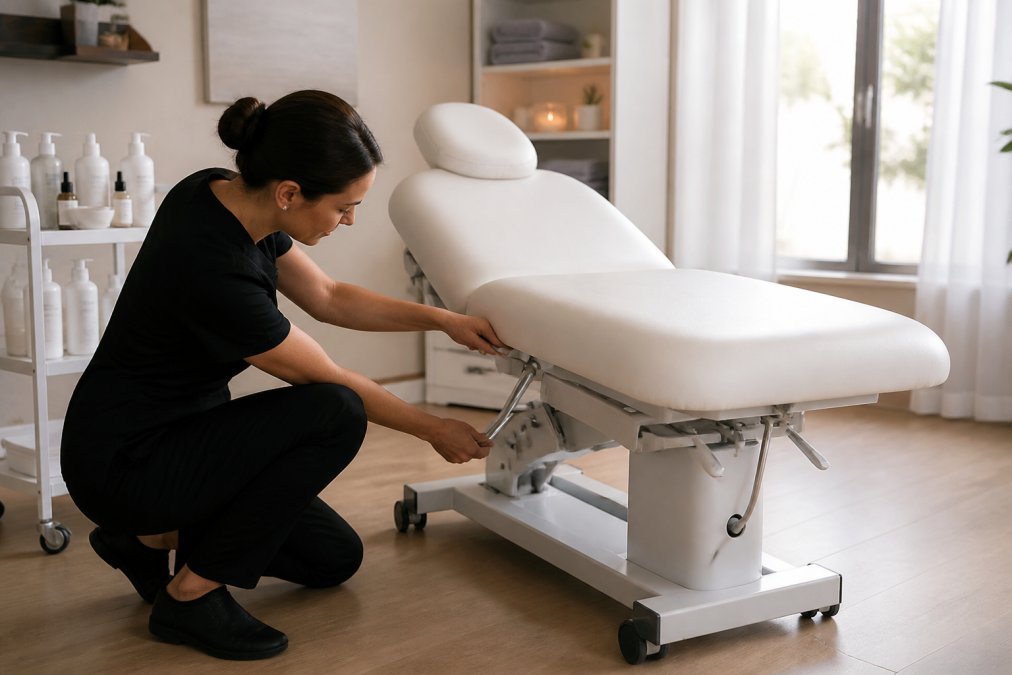
Spa equipment maintenance tips that actually extend table life come down to a short weekly routine. Wipe upholstery after every client with a mild disinfectant, not an abrasive cleaner. Check bolts and lift mechanisms monthly. Lubricate moving parts according to the manufacturer's schedule.
A simple maintenance checklist:
- Wipe the surface after each client with a pH-neutral disinfectant
- Inspect seams and corners weekly for cracks or lifting
- Tighten frame bolts and check base feet monthly
- Test the lift through its full range every week
- Keep a repair log so you spot recurring issues
Ergonomics and Space: Setting Up Your Treatment Room
Ergonomics protect the practitioner as much as the client. Most estheticians spend six to eight hours a day bent over a table, and the cumulative load on the low back, neck, and wrists drives many out of the field early. A durable table is only half the equation, how you set it up determines whether your body lasts as long as the frame.
Set the working height to your body, not the room
The correct working height is where your forearms rest roughly parallel to the floor with your hands on a client's face. For most standing practitioners that's 30 to 34 inches at the top of the upholstery, but it's personal, taller estheticians often need 36 inches or more, shorter ones may work at 28 to 30. That's why electric and hydraulic adjustability matters beyond client comfort: you can switch between a seated facial and a standing waxing service without compromising posture.
The three strain patterns to design against
- Forward neck flexion. Leaning over a client for a 60-minute facial loads the cervical spine. A face cradle that tilts independently lets you bring the client's head toward you instead of you folding toward them.
- Wrist extension during extractions and massage. Working with your wrists bent back compresses the carpal tunnel. Keep the table high enough that your hands stay neutral, and keep your tools within a short reach so you are not twisting to grab them.
- Static standing on hard floors. Anti-fatigue mats are not a luxury in a treatment room. A half-inch mat at the working side of the table reduces the load on your feet, knees, and low back across a full appointment book.
Space planning around the table
For small studios, a stationary table with a compact footprint beats a portable one you never fold. Leave at least two feet of clearance on the working side, enough to kneel, turn, and reach a trolley without stepping over the client. Three feet is better for waxing or body treatments that require moving around the table.
- Magnifying lamp. Mount it on a rolling base or an articulating arm so you can swing it over the client's face without leaning in. A lamp clamped to the table adds weight to the frame and can tip a lighter model.
- Steamer. Place it on the opposite side of the table from your working position so the hose reaches the client's face without crossing your body. Keep the reservoir accessible for refills between clients.
- Trolley. Position it within arm's reach of your dominant hand at the head of the table. If you have to step away mid-service to grab product, you are losing time and breaking your posture.
- Stool. A rolling stool with a backrest lets you sit for long extractions and stand for massage without moving the table.
Match the table type to how you actually work
Frequently Asked Questions
What is the lifespan of a professional treatment table?
A well-built treatment table used daily in a busy practice typically lasts 5 to 10 years. Lifespan depends on frame construction, upholstery quality, and how closely you follow maintenance routines. Tables with heavy-duty steel frames, high-density foam, and oil-resistant vinyl tend to reach the upper end. Replacing worn upholstery and tightening hardware every few months can extend the life of your table well beyond the average.
How much weight capacity should a professional treatment table have?
For most esthetics practices, a treatment table weight capacity of at least 400 to 500 pounds covers standard client needs with a safety margin. If you offer services to larger clients or use the table for waxing, massage, or body treatments, look for 600 pounds or more. Always check the weight limit against the combined weight of the client and any equipment you place on the table.
What features make a treatment table durable for daily spa use?
Look for a heavy-duty steel or aluminum frame, high-density foam that resists compression, and oil-resistant upholstery that wipes clean without cracking. Welded joints, reinforced base stability, and quality hydraulic or electric actuators also signal a table built for daily use. A removable face cradle and adjustable backrest add versatility without sacrificing structural strength.
How do I maintain my treatment table to prevent early wear?
Wipe upholstery after every client with a mild, non-abrasive disinfectant to protect the vinyl. Check and tighten bolts, screws, and hydraulic fittings monthly. Lubricate moving parts like the backrest hinge and height adjustment mechanism every few months. Keep the table away from direct sunlight, which dries out upholstery, and repair small tears promptly before they spread and expose the foam.
Choosing the right furniture is one decision. Keeping it in service for years is another. SkinAct designs and engineers treatment furniture for medical spas, estheticians, and salons, with strict quality control standards, factory-direct pricing, and dependable long-term supply across every location you open. Get started with SkinAct and equip your treatment rooms with furniture built to last.