Is Medical Spa Interior Design Worth the Investment?
Quick Summary
Medical spa interior design is worth the investment when it supports the treatments you sell, makes the room easier to work in, and holds up to daily use. Start by judging design against those three questions before committing to a budget. Furniture and storage typically carry the clearest return.
- Judge design by whether it supports your treatments, eases daily work, and withstands daily use.
- Map each treatment's workflow so staff never leave the client unattended mid-service.
- Choose cleanable, non-porous surfaces for counters, floors, and upholstery in treatment zones.
- Divide the upgrade cost by contribution margin per treatment to estimate how many treatments pay it back.
- Upgrade one room at a time and schedule large changes during your slowest periods.
Table of Contents
- Why Medical Spa Interior Design Is Harder to Judge Than Other Upgrades
- Medical Spa Interior Design Ideas That Affect Client Experience
- Medical Spa Treatment Room Design: Where Function Carries the Budget
- Medical Spa Design Trends and Which Ones Age Well
- Costs, Budgets, and Payback: Comparing Professional Design With Lower-Cost Alternatives
- Medical Spa Renovation Planning: Sequencing Upgrades to Protect Revenue
- Choosing Your Treatment Furniture and Next Steps for Your Build-Out
- Frequently Asked Questions
Is Medical Spa Interior Design Worth the Investment for SkinAct Clients?
Last Updated: November 5, 2026
Why Medical Spa Interior Design Is Harder to Judge Than Other Upgrades
Medical spa interior design is one of the few upgrades that is hard to measure. A new treatment table or a better storage cart has a clear function. A redesigned room affects how clients feel, how fast staff move, and how the practice presents itself, and none of those effects appear on a single invoice. This is why many owners struggle to decide whether design spending is worth it.
SkinAct supplies the furniture that fills these rooms. The question is not whether design matters. It is which design decisions earn their cost back.
Most owners find it easier to judge design in terms of three questions: does it support the treatments you sell, does it make the room easier to work in, and does it hold up to daily use? Answer those first, and the budget conversation becomes much clearer.
Medical Spa Interior Design Ideas That Affect Client Experience
Client experience starts before the first treatment. The waiting area, the hallway and the first treatment room all shape how a client judges the practice. Lighting, color, and the feel of the furniture are the most visible design choices, and they are also the easiest to change without rebuilding the space.
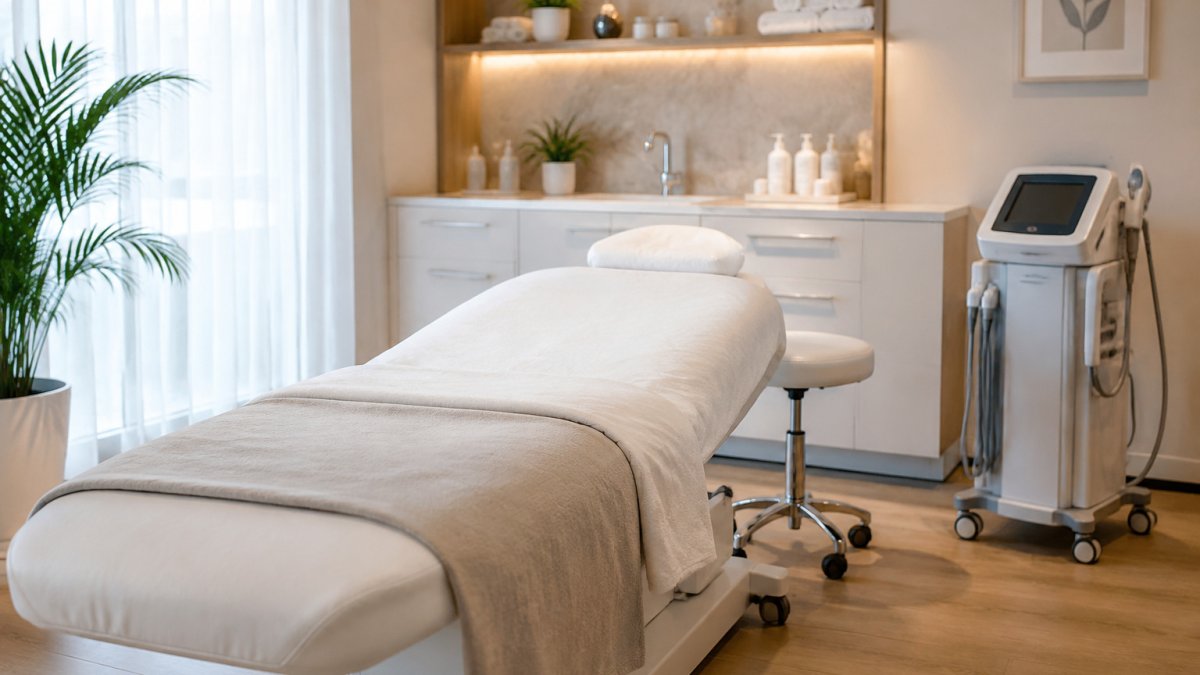
Warm, indirect lighting and a clear, uncluttered layout tend to make rooms feel calmer. Wood tones and natural textures are a common choice for a spa feel. The Serene Professional Electric Treatment Table with Ambient LED Lighting, priced at $3,899.00, includes a premium solid wood base and integrated LED underglow that provides a soft, non-disruptive glow suited to low-light massage modalities.
Design ideas should match your service menu. A room built for facials needs different surfaces and storage than one built for body contouring. Start with the treatments you perform most often, then choose finishes and fixtures that support them.
Medical Spa Treatment Room Design: Where Function Carries the Budget
A medical spa treatment room is not a day spa room with a different sign on the door. It has to support clinical workflow, protect client privacy, hold up to sanitation protocols, and meet accessibility expectations, and those requirements drive layout and furniture choices far more than color palettes do.
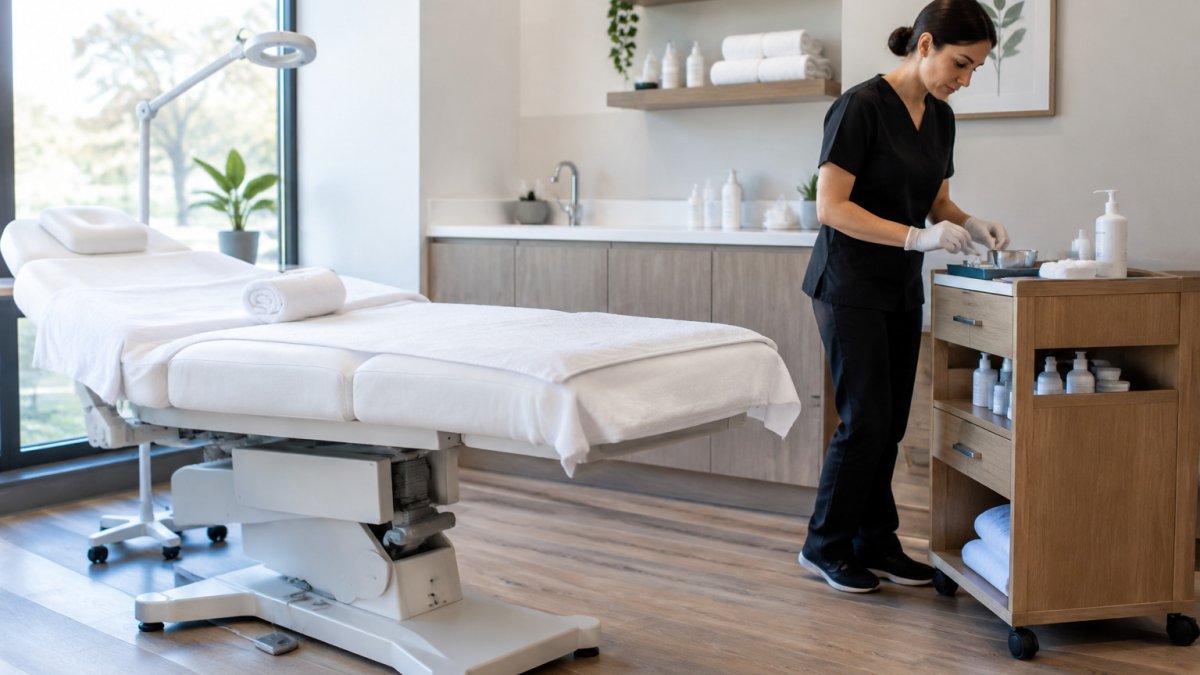
Clinical workflow. Map the sequence of a typical treatment, intake, cleansing, the procedure itself, aftercare, and checkout, and place storage, waste, and hand-washing so staff never have to leave the client unattended mid-service. Mobile storage is the cheapest way to close workflow gaps.
Privacy. Treatment rooms need acoustic separation and a door that closes fully, not a curtain, because clients undress and discuss medical history. Plan the room so the treatment table is not visible from the doorway when the door opens, and use solid-core doors and weatherstripping to reduce sound transfer between rooms.
Sanitation and surfaces. Choose non-porous, cleanable surfaces for counters, floors, and upholstery, and avoid porous wood or fabric in areas where products and instruments are handled. Treatment tables and chairs should have upholstery that withstands the disinfectants your protocols require; check the manufacturer's cleaning guidance before purchase.
Accessibility. Wider doorways, clear floor space around the table, and a path that accommodates mobility devices are increasingly expected and, depending on the building and jurisdiction, may be required under the Americans with Disabilities Act (ADA) for areas of public accommodation. Confirm requirements with your local building authority during planning rather than after construction begins.
Licensing and scope-of-practice considerations. In many states, the treatments a medical spa offers are regulated, and the room layout may need to support supervision requirements, locked storage for certain products, and documentation areas.
Furniture that carries the function. In a treatment room, function usually matters more than decoration. Staff need to reach supplies without leaving the client, and the layout should reduce wasted steps during each service. Storage placement, table positioning, and clearances around equipment all affect daily efficiency. Electric tables and chairs with powered positioning can reduce the physical effort of repeated height and recline adjustments across a full schedule.
Check the weight capacity and build quality against how many clients you see each day before you decide.
Medical Spa Design Trends and Which Ones Age Well
Design trends move quickly, and many of them look dated within a few years. Bold accent colors, heavy patterns, and highly specific themed decor are the most likely to feel out of style. Neutral palettes, natural materials, and simple lines tend to hold their appeal longer. The same preference for enduring materials and clean lines can guide custom lobby fabrication, helping the entrance feel cohesive with the rest of the spa.
Durable choices generally hold their value better than trendy ones. A neutral room with good lighting and solid furniture can be refreshed with textiles and accessories at a lower cost than a full rebuild. Trends are easiest to adopt in small, replaceable elements.
Serene Professional Electric Treatment Table with Ambient LED Lighting →
The trends worth considering are the ones tied to how clients use the space, such as clear wayfinding, comfortable seating, and lighting that can be adjusted by treatment type. Those features support the client experience regardless of what is fashionable.
Costs, Budgets, and Payback: Comparing Professional Design With Lower-Cost Alternatives
The investment question only becomes answerable once you separate the three cost layers that get bundled together in most renovation quotes: design fees, construction and finishes, and treatment furniture. Each layer has a different payback logic, and each can be phased independently.
Design fees. Interior designers who specialize in clinical and spa spaces typically charge either a flat project fee or an hourly rate. Fees generally scale with the scope of space planning, finish selection, and coordination with contractors and equipment vendors. Ask for a fee proposal that itemizes space planning, finish selection, and construction administration separately, so you can drop the pieces you do not need.
Construction and finishes. The largest variable is whether walls, plumbing, or electrical move. Cosmetic-only work, paint, flooring, lighting fixtures, millwork, is dramatically cheaper per room than reconfiguring a layout. A common pattern is that owners underestimate electrical work: adding dedicated circuits for treatment tables with powered features, adjustable lighting, and equipment often requires an electrician and can add meaningfully to the budget. Get a licensed electrician's walkthrough before you commit to a table with powered positioning.
Treatment furniture. This is the layer with the clearest per-unit cost and the fastest payback, because it can be ordered, delivered, and put into service without closing a room. The table below compares the main products in this guide. Prices are the starting prices listed on SkinAct's site.
| Product | Starting Price | Best For | Key Feature |
|---|---|---|---|
| Serene Professional Electric Treatment Table | $3,899.00 | Day spas and medical wellness centers | Ambient LED underglow, solid wood base |
| Alora Electric Treatment Chair | $2,599.00 | Spas and treatment rooms needing precise positioning | Four electric motors, dual-sided foot controls |
| Lucera Electric Treatment Chair | $2,399.00 | Professional spa and salon treatment rooms | Four electric motors, handheld remote |
| Salon Spa Cart with Two Drawers | $229.00 | Mobile storage for tools and products | Two locking drawers, four casters |
| Moda Wooden Spa Trolley Cart | $199.00 | Styled rooms wanting wood finish | Three open shelves, one drawer |
Professional design versus lower-cost alternatives. Hiring a specialist buys space planning that accounts for clinical workflow, sanitation surfaces, privacy, and accessibility, the things a general contractor is not trained to solve. A general contractor can execute a plan, but layout planning for clinical workflow is a separate skill.
Financing and payback math. Equipment financing, small-business lines of credit, and vendor payment plans are the common ways practices spread the cost of furniture and construction. To estimate payback, use a simple break-even formula: divide the total upgrade cost by the contribution margin per treatment (the treatment price minus the direct cost of products and staff time). The result is the number of additional treatments needed to recover the spend.
Watch out: do not sign a construction contract before you have confirmed that the electrical, plumbing, and equipment specifications match the treatment tables and chairs you intend to buy, mismatches here are the most common source of change orders and budget overruns.
Medical Spa Renovation Planning: Sequencing Upgrades to Protect Revenue
A renovation that closes rooms for weeks can cost more than the upgrade saves. Plan work so that one room is upgraded at a time, and schedule the largest changes during your slowest periods. Ordering furniture early helps avoid delays that leave rooms empty.
Start with the rooms that produce the most revenue or cause the most daily friction. Lighting and storage are often quick, low-disruption upgrades. Large fixed changes, such as moving plumbing or walls, usually take longer and should be planned well in advance.
Keep a written schedule that lists each room, the work involved, and the expected downtime. Share it with your staff so that bookings can be adjusted before work begins.
Choosing Your Treatment Furniture and Next Steps for Your Build-Out
Start by listing the treatments you perform, the number of clients per day, and the space each room has. Those three inputs will narrow the choice quickly. Compare weight capacity, adjustability, and storage against your daily workload, and decide whether you need fixed or mobile pieces.
If you are planning a build-out, you can explore our electric treatment chairs, tables, and carts on the SkinAct website. Each product page lists its specifications, which makes it easier to compare options against your room plan. If your team is also looking to add new modalities or services, our Online Service Training for Estheticians courses are another resource to consider alongside room planning.
Frequently Asked Questions
Does medical spa interior design actually increase revenue?
Design alone rarely produces revenue by itself. It supports results through client comfort, a clear treatment flow, and a space that matches the prices you charge. Owners usually see the clearest return when a redesign removes a specific friction, such as slow room turnover, cramped workstations, or clients who feel rushed. Track rebooking rates, room utilization, and average ticket size for at least a few months before and after a change so you can separate design effects from seasonal or marketing effects.
How much should a medical spa budget for interior design?
Budgets vary widely by square footage, number of treatment rooms, and how much of the work is cosmetic versus structural. A practical approach is to set aside money first for functional equipment and layout decisions, then allocate the remainder to finishes and lighting. SkinAct's Serene Professional Electric Treatment Table is listed at $3,899.00, the Alora and Lucera powered treatment chairs at $2,599.00 and $2,399.00, and the Salon Spa Cart with Two Drawers at $229.00, which gives a concrete baseline for furniture line items in a build-out plan.
Can a medical spa improve its look without a full renovation?
Yes. Targeted changes such as lighting, a wood-grain storage cart like the Moda Wooden Spa Trolley Cart at $199.00, and consistent upholstery colors can shift the feel of a room without structural work. Start with the spaces clients see most, usually the reception area and the treatment room, and keep the changes modular so they can be expanded later.
What is the difference between professional medical spa design and a lower-cost alternative?
Professional design typically covers space planning, workflow, material durability, and compliance with the practice's operating needs, while lower-cost alternatives focus mainly on decor. The trade-off is that decor-only approaches are cheaper to start but may need rework when workflow problems appear. Compare both options against the same list of daily tasks in your treatment rooms before deciding.
Medical spa interior design is worth the investment when it supports the treatments you sell, makes each room easier to work in, and holds up to daily use. SkinAct's treatment furniture and carts are built for professional spas and medical wellness practices, with prices and specifications listed on each product page so you can plan your build-out with confidence.