Which Lighting Works Best for Massage Rooms?
Last Updated: November 3, 2026
Quick Summary
The best massage room lighting layers two sources: a dimmable ceiling fixture with a diffused lens for overall light, and a separate task light for skin assessment. Keep ambient light warm, around 2700K to 3000K, so it feels calm during massage. Choose a higher CRI for any light used to assess skin tone.
- Choose a dimmable fixture so light can drop to about 10 percent for massage.
- Warm 2700K to 3000K light feels calmer than cool white during treatments.
- Pick a CRI of 90 or higher for any light used during skin assessment.
- Use a flicker-free LED driver to avoid eye strain in long sessions.
- Keep the task light on its own switch so it stays off during massage.
Table of Contents
- Why Lighting Matters More Than Most Treatment Rooms Admit
- What to Look for in Massage Room Lighting: Lumens, Kelvin, CRI and Flicker
- 1. Ambient LED Underglow on an Electric Treatment Table
- 2. Dimmable Ceiling Fixtures With Diffused Lenses
- 3. Warm Table and Floor Lamps for Layered Light
- 4. Accent Lighting for Mood Without Glare
- 5. Task Lighting for Facial and Skin Assessment
- 6. Magnifying Task Lamps for Detailed Skin Work
- 7. Choosing the Right Setup for Your Room
- Frequently Asked Questions
Why Lighting Matters More Than Most Treatment Rooms Admit
Good massage room lighting shapes how a client feels from the moment they walk in. Treatment rooms that look polished can still feel harsh when the light was chosen for convenience instead of comfort. The right setup lets a client relax, and it lets the practitioner see skin clearly when the work requires it.
Most rooms need two things at once: soft, low-level light during massage and enough focused light for skin assessment. Those needs pull in opposite directions, which is why a single overhead fixture rarely works. The seven options below are built around layering light so each task gets what it needs.
What to Look for in Massage Room Lighting: Lumens, Kelvin, CRI and Flicker
Four specifications decide whether a fixture will serve a treatment room well. Lumens measure brightness, so a dimmable source lets you lower output for massage and raise it for skin work. Kelvin measures color temperature, and warm light around 2700K to 3000K tends to feel calmer than cool white. CRI, or color rendering index, shows how accurately light reveals true skin tone; a higher score matters when you assess redness or pigmentation. Flicker, often hidden in cheap LED drivers, can cause eye strain during long sessions, so look for flicker-free products.
A practical approach is to keep brightness adjustable, stay in the warm range for ambient light, and choose a higher CRI for any light used during assessment. A common mistake is buying the brightest fixture available and then having no way to dim it.
1. Ambient LED Underglow on an Electric Treatment Table
The Serene Professional Electric Treatment Table with Ambient LED Lighting places a soft glow beneath the table itself. Its LED underglow is designed to create a soft, non-disruptive glow suited to low-light massage modalities.
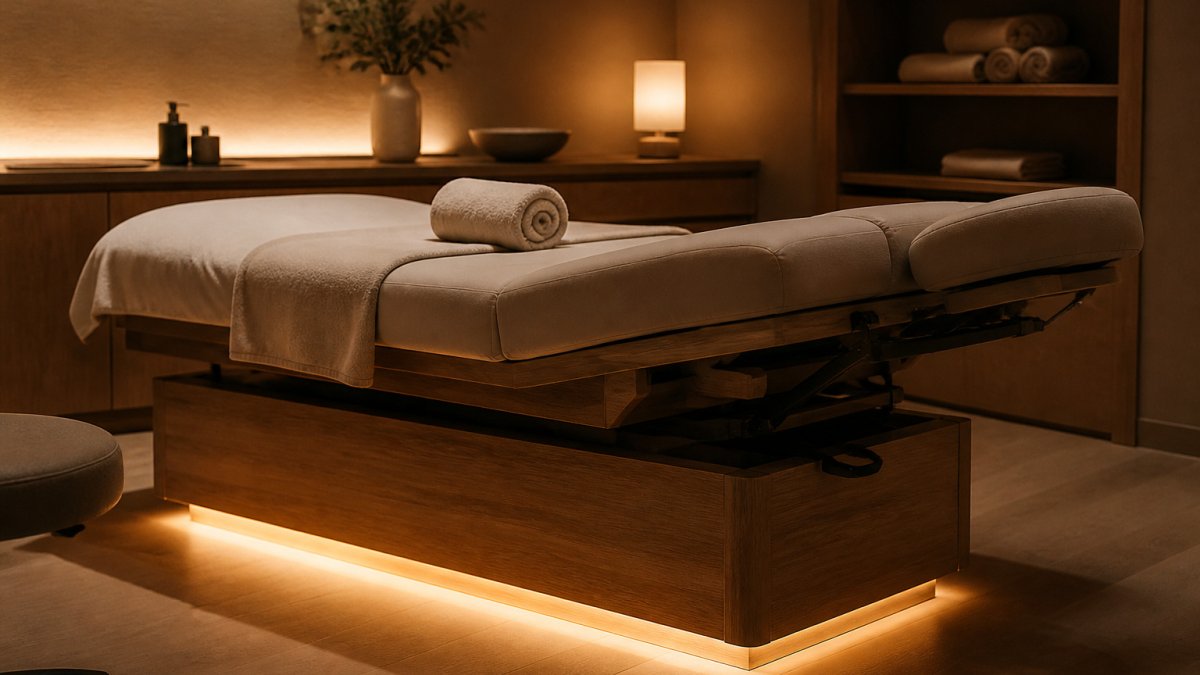
Best for: practices that want mood lighting built into the treatment furniture itself. Skip if: you need bright, direct light for detailed skin work, since underglow is ambient rather than task light. At $3,899.00, it is a major furniture purchase, so plan it into your room build.
Serene Professional Electric Treatment Table with Ambient LED Lighting combines an ambient LED underglow with an electric lift.

2. Dimmable Ceiling Fixtures With Diffused Lenses
Ceiling fixtures remain the backbone of most treatment rooms, but the difference between a fixture that works and one that fights you comes down to four specifications: lumens, Kelvin, CRI, and dimmer compatibility. A dimmable model with a diffused lens spreads light evenly and avoids hot spots on the table, and pairing it with a compatible dimmer switch lets the room move from full light for consultation to a low glow for massage.
For a typical treatment room, most practitioners find a base fixture in the 2,000 to 3,000 lumen range gives enough headroom for cleaning and setup, while dimming down to roughly 10 percent output covers massage. Warm 2700K to 3000K light feels calmer than cool white, and a CRI of 90 or higher is worth paying for if the same fixture will be used during skin assessment. Check that the dimmer is rated for the fixture's LED driver; mismatched dimmers are a common cause of buzz, flicker, and premature failure. For a wider view of outfitting a full build-out, see outfitting multiple medical spa locations.
Best for: rooms that need one main light source that can be controlled across tasks. Skip if: your ceiling cannot take recessed hardware, or your wiring cannot support a dimmer.
Watch out: cheap LED drivers often introduce flicker that is invisible at full brightness but noticeable at low dim levels, so ask for a flicker-free driver or test the fixture at 10 percent before committing to a room full of them.
3. Warm Table and Floor Lamps for Layered Light
Portable lamps add layers without rewiring. A table lamp on a side cabinet or a floor lamp in a corner creates pools of warm light that make a room feel lived in rather than clinical. Use a warm-toned bulb, around 2700K, and keep the shade diffusing so the lamp itself does not glare.
Best for: small rooms and solo practitioners who want flexibility without construction. Skip if: cords would cross the treatment area, since trip hazards matter during active sessions.
4. Accent Lighting for Mood Without Glare
Accent lights highlight a feature such as a wall, shelf or plant rather than lighting the client. They add depth and atmosphere while keeping the light away from the face. Position accents low and to the side, and aim them at surfaces, not at the treatment table.
Best for: adding visual interest in larger rooms. Skip if: the room is very small, because accent light can make a tight space feel crowded.
5. Task Lighting for Facial and Skin Assessment
Facial work requires clearer light than massage. A focused task light with higher CRI lets you see skin tone and texture accurately. Keep it on a separate switch so you can use it during assessment and turn it off during massage.
Serene Professional Electric Treatment Table with Ambient LED Lighting →
Use a neutral to warm-neutral color temperature here, and check that the light does not reflect off the client's face or eyes. Our recommendation is a task light you can position independently of the ambient fixtures. Estheticians who want to build confidence in skin assessment alongside their lighting setup can explore the Online Service Training for Estheticians available on SkinAct.
6. Magnifying Task Lamps for Detailed Skin Work
When detailed skin work calls for magnification, a magnifying lamp combines close inspection with task light. Several SkinAct options fit this role. The LED Magnifying Lamp 5x Diopter Magnifier features an adjustable arm and a 1-year limited warranty, at $129.00.

For a rolling floor model, the Elemento LED Magnifying Lamp and the Moda LED Magnifying Lamp both offer touch-control brightness, each at $139.00. The Moda specifies 800 lumens from a 9W LED and carries ETL and CETL certification.

Best for: estheticians doing close skin analysis or detailed work. Skip if: you only need general room light, since a magnifier is a task tool rather than an ambient one.
Magnifying lamps are not a substitute for the ceiling and accent fixtures above. Use them alongside your room lighting, and position them so the light falls on the work area rather than the client's eyes.
7. Choosing the Right Setup for Your Room
Most lighting guides stop at "layer your light." A decision-ready plan goes further: rank the seven options by task fit, match color temperature to the work being done, and account for what the fixture costs to own over time.
Ranked by task fit for a typical treatment room:
- Dimmable ceiling fixture with a diffused lens, base light for every task; the one fixture almost every room needs.
- Task lighting for facial and skin assessment, the second must-have if you do skin work.
- Warm table and floor lamps, cheapest way to add layered ambiance without rewiring.
- Ambient LED underglow on an electric treatment table, strong mood effect, but tied to a furniture purchase.
- Magnifying task lamps, essential only for detailed skin work, not general lighting.
- Accent lighting, atmosphere only; lowest priority in small rooms.
- (Reserve), skip any fixture that duplicates a task already covered by a higher-ranked option.
Match color temperature to the task. Warm 2700K to 3000K light supports relaxation during massage and low-light modalities. Neutral 3500K to 4000K light with a CRI of 90 or higher is more useful for setup, cleaning, and detailed skin assessment, because it reveals redness and pigmentation more accurately. A common pattern is to keep ambient fixtures warm and reserve the neutral, higher-CRI output for a separate task light on its own switch.
Account for total cost of ownership. Purchase price is only part of the picture. LED fixtures generally last longer than incandescent bulbs and draw less wattage, which can offset a higher upfront price through lower energy use and fewer replacements. When comparing options, note the wattage, the rated lifespan, and whether the bulb or LED module is replaceable; a fixture with a sealed, non-replaceable module becomes a full replacement when it fails.
Plan for safety and cleaning. Keep cords routed away from the treatment area, confirm fixtures are stable and rated for the room's moisture level, and choose surfaces that wipe down easily between clients. Confirm the electrical plan with a licensed electrician before installation.
Offer clients control. Light sensitivity, migraines, and visual impairments are common, so give clients a simple way to dim or switch off ambient light without disrupting the treatment. A dimmer within reach or a hand-held remote solves most of this.
Budget matters, but so does consistency. If you run several rooms, matching fixtures across them keeps the experience uniform for clients and simplifies replacement parts later. SkinAct supplies professional spa equipment and treatment furniture for medical spas, estheticians and salons. Explore the full range to build a room that fits your practice.
The table below ranks the seven options by task fit, using the guidance in the article.
| Option | Best for | Key difference |
|---|---|---|
| Dimmable ceiling fixture | Base light for every task | Diffused lens; dimmable across tasks |
| Task lighting | Facial and skin assessment | Separate switch; higher CRI |
| Warm table and floor lamps | Layered ambiance without rewiring | Warm 2700K bulb; diffusing shade |
| Ambient LED underglow table | Mood lighting in the treatment furniture | Ambient, not task light |
| Magnifying task lamps | Detailed skin work | Task tool, not ambient light |
| Accent lighting | Atmosphere in larger rooms | Aimed at surfaces, not the client |
Frequently Asked Questions
What is the ideal lighting for a massage room?
Layered, low-intensity light works best. Combine a dimmable ceiling fixture with diffused lenses, warm-toned bulbs in the 2700K to 3000K range, and a separate task light you can switch on for skin assessment. Avoid exposed bulbs placed in the client's line of sight, since glare makes it hard for clients to relax. Aim for a room you can dim well below full brightness during massage and raise quickly for intake and aftercare. Pairing a warm ambient source with a neutral task light gives you both atmosphere and accurate color for skin checks.
What color temperature is best for massage room lighting?
Most massage and facial rooms use warm white light between about 2700K and 3000K, which feels calm and relaxing. For skin assessment, a neutral task light around 4000K gives more accurate color, so many practices use two sources: warm ambient light during treatments and a brighter, cooler task light for consultations. Check that bulbs carry a high CRI rating, ideally 90 or above, so skin tones look natural under both settings.
How can you dim massage room lights?
Install a dimmer switch rated for LED loads, since standard dimmers can cause flicker or buzzing with some LED bulbs. Choose bulbs labeled dimmable and confirm compatibility with the dimmer model before purchase. Smart dimmers or wall controls let you set preset scenes for intake, treatment and checkout. Ask a licensed electrician to install dimmers and any new fixtures.
How bright should a massage room be?
Most practitioners keep ambient light low enough that the room feels restful, then raise brightness for intake, documentation and aftercare. Because brightness needs vary by treatment, a dimmable setup gives you control rather than a single fixed level. Measure light output in lumens when comparing fixtures, and look for products that deliver even illumination without hot spots or glare on the treatment surface.