Ultimate Guide to Outfitting Multiple Medical Spa Locations
Table of Contents
- Why Outfitting Multiple Medical Spa Locations Requires a Different Strategy
- Opening a Second Med Spa Location: Planning Your Equipment Needs
- Medical Spa Equipment Standardization Across Locations
- Medical Spa Treatment Room Setup: Room-by-Room Outfitting
- Medical Spa Equipment Checklist for Multi-Location Operations
- Managing Inventory, Procurement, and Vendor Relationships
- Tracking Performance and Use Across Locations
- Frequently Asked Questions
Outfitting Multiple Medical Spa Locations: A Strategic Guide to Equipment and Operations
Last Updated: October 12, 2026
Why Outfitting Multiple Medical Spa Locations Requires a Different Strategy
Running two, three, or five medical spa locations introduces operational challenges most guides overlook. The difference isn't buying more equipment, it's building systems that scale.
Opening a second location raises new questions: identical equipment at each site or customization for local needs? How do you ensure consistent client experience without micromanaging? How do you keep supply costs from spiraling as inventory spreads?
At SkinAct, we've worked with owners navigating these challenges. Those who succeed treat multi-location outfitting as a strategic decision, not a repeat purchase, standardizing core treatment equipment, client intake, and core furniture while leaving room for site-specific adaptations.

Outfitting multiple medical spa locations requires planning around three core variables: standardization (what stays the same everywhere), customization (what changes by location), and systems (how you manage it all). Get these right, and you build a scalable operation.
Opening a Second Med Spa Location: Planning Your Equipment Needs
Before ordering equipment, understand what each location will actually do. A second location isn't a clone, it operates in a different market, serves a different client base, and may have different space constraints.
Site-Specific Assessment and Layout
A downtown location might have smaller treatment rooms but higher foot traffic; a suburban one might have more square footage but lower volume.
Measure treatment rooms precisely, ceiling height, doorway widths, electrical outlets, plumbing access. These constraints determine what you can install.
Ask: How many treatment rooms? What treatments will each offer? Same service mix or different modalities? A laser-focused location needs different equipment than one emphasizing massage and facials, which changes your procurement strategy.
Consider traffic patterns. A high-volume location needs durable equipment built for frequent use; a boutique location may prioritize aesthetics over throughput.
Treatment Room Configuration
Treatment room layout determines how efficiently your estheticians work. Poor layout wastes time. Good layout keeps practitioners moving and clients comfortable.
Map the workflow for each room: where clients enter and change, where the esthetician washes hands, where supplies are stored, where the table sits.
Electrical and plumbing requirements matter more than most owners realize. Facial rooms need hand-washing stations, laser rooms need dedicated circuits, Hydrafacial rooms need water access. Plan placement before construction or renovation.
Consider ambient conditions. Some equipment is sensitive to humidity or temperature, and high-humidity environments require different considerations than dry rooms.
Medical Spa Equipment Standardization Across Locations
Standardization is where multi-location operations become manageable or spiral into chaos. The goal isn't identical locations, it's consistency in the areas that matter most to client experience and operational efficiency.
Selecting Core Equipment That Works Everywhere
Core treatment equipment should be the same across all locations, it defines your service offerings and client experience. Clients who expect a specific facial or laser procedure expect the same equipment and results everywhere.
Core equipment typically includes treatment tables, esthetician chairs, and primary treatment devices, the tools that deliver your signature services. Consistency builds brand trust: a client who loved your first location expects the same experience at your second.
Supporting equipment, storage carts, stepstools, mirrors, lighting, can vary by room layout and local needs. Flexibility here lets you adapt to each location's physical constraints without compromising core services.
Standardizing also simplifies procurement and maintenance: the same table model across five locations means better pricing, spare parts on hand, and staff trained on familiar tools. When your team is trained on consistent equipment, onboarding new estheticians becomes faster and more efficient, and resources like Online Service Training for Estheticians can help ensure your staff is proficient with your standardized equipment across all locations.
Documenting Your Standard Equipment Specifications
Create a master equipment list specifying exactly what goes in each treatment room, model numbers, dimensions, weight capacity, electrical requirements, warranty details. This becomes your procurement blueprint for every new location.
Document not just what equipment you use, but why. Note which features matter most, height range, motor reliability, upholstery durability.
Include furniture specs too, exact esthetician chair model, storage cart dimensions, stool height. These details seem minor but affect workflow and staff comfort across locations.

Keep this documentation updated. The first location is a prototype; by the third, you should have optimized your choices based on real-world experience.
Medical Spa Treatment Room Setup: Room-by-Room Outfitting
A well-outfitted treatment room balances functionality, comfort, and efficiency. Every item serves a purpose. Every placement affects workflow.
Essential Furniture for Treatment Rooms
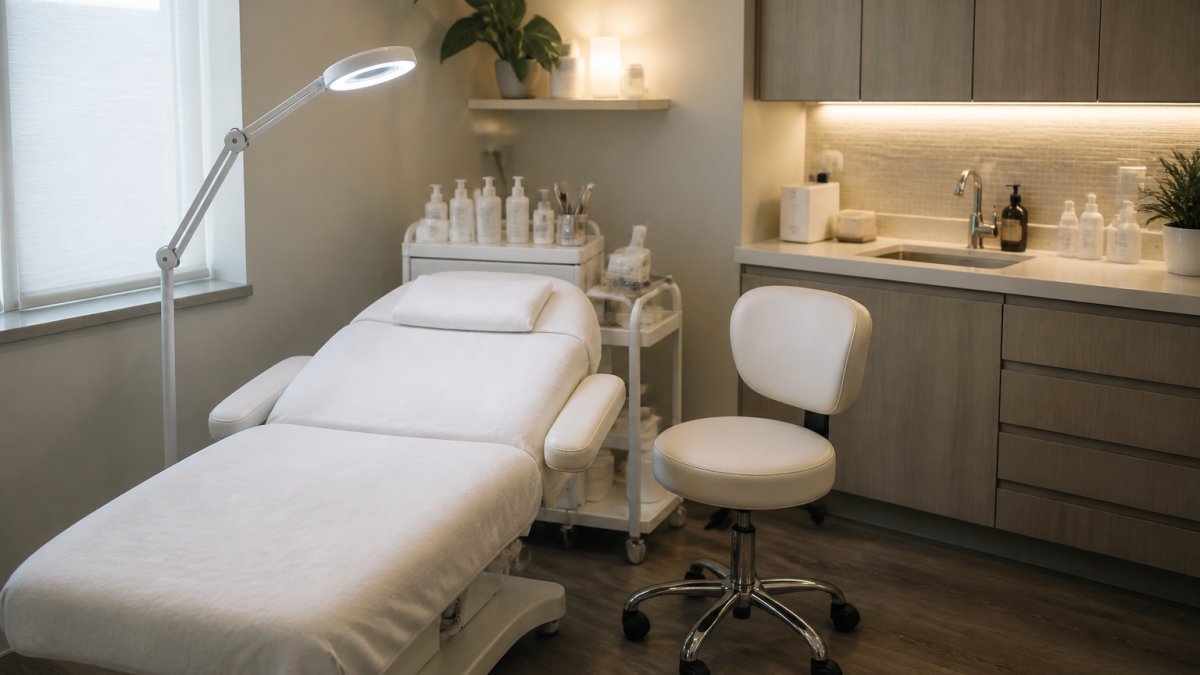
The treatment table is the centerpiece of every room. For multi-location operations, choose a fully electric model with programmable positions.

The esthetician chair is where the practitioner spends hours each day. Choose adjustable height, lumbar support, and swivel capability, comfort directly affects staff retention and treatment quality.
A mobile storage cart keeps supplies organized and accessible. Look for multiple drawers, smooth-rolling wheels, and sturdy construction so it repositions easily as treatments change.
Additional furniture includes step stools, mirrors, and side tables.
Storage, Workflow, and Client Experience
Organization affects both efficiency and client perception. Clients notice clutter; a well-organized room feels professional and calming.
Dedicate storage by category: treatment supplies separate from cleaning supplies, linens separate from products, with labeled drawers and shelving so any staff member can find what they need quickly.
Soft, adjustable lighting creates a calming environment. Some treatment tables, like the SkinAct Serene model, include integrated LED underglow that sets a spa atmosphere while providing practical illumination.
Climate control matters too. Treatment rooms should be comfortable for both client and practitioner, and humidity control is critical in rooms with water-based treatments.
Medical Spa Equipment Checklist for Multi-Location Operations
A comprehensive checklist ensures you don't miss essential items when outfitting a new location, and becomes your procurement template.
MediSpa Ultimate Starter Kit →
| Equipment Category | Item | Quantity | Notes |
|---|---|---|---|
| Treatment Furniture | Electric treatment table | 1 per room | Fully electric, 4-motor preferred |
| Treatment Furniture | Esthetician chair | 1 per room | Adjustable height, swivel |
| Treatment Furniture | Mobile storage cart | 1-2 per room | Multiple drawers, smooth wheels |
| Treatment Furniture | Step stool | 1 per room | Sturdy, non-slip surface |
| Lighting & Ambiance | Overhead lighting | As needed | Dimmable, adjustable color temp |
| Lighting & Ambiance | Task lighting | 1-2 per room | Focused on treatment area |
| Lighting & Ambiance | Ambient LED accents | Optional | Integrated in treatment table |
| Mirrors & Accessories | Wall mirror | 1 per room | Positioned for client view |
| Mirrors & Accessories | Hand mirror | 1 per room | For close-up client viewing |
| Storage & Organization | Shelving units | 2-3 per room | Closed or open, labeled |
| Storage & Organization | Towel warmer | 1 per room | Professional grade |
| Support Equipment | Hand-washing station | 1 per room | Separate from client area |
| Support Equipment | Trash receptacle | 1 per room | Covered, easy to empty |
| Support Equipment | Biohazard disposal | 1 per room | If needed for procedures |
Treatment Room Essentials
Every treatment room needs a fully electric treatment table, your largest equipment investment per room and where clients spend their time.
Pair the table with a professional esthetician chair positioned for optimal access, allowing the practitioner to reach different areas without straining.
Storage must be accessible but organized: a mobile cart keeps supplies within reach, wall-mounted shelving stores larger items and linens, and drawers keep small supplies out of sight.
Lighting should be adjustable: overhead for general illumination, task lighting focused on the treatment area, and dimmable controls so practitioners can adjust brightness by treatment type and client preference.
Support and Administrative Spaces
Beyond treatment rooms, you need support spaces. Reception areas need comfortable seating and a functional desk. Staff areas need lockers and a break space.
Client comfort in waiting areas matters: comfortable seating, pleasant lighting, and temperature control shape perception before a client even enters a treatment room.
Staff areas should be separate from client areas. Staff need a secure place to store personal items, take breaks, and prepare for treatments.
Administrative spaces need secure storage for client records, filing systems for paper intake forms, computers and secure network access for digital systems.
Managing Inventory, Procurement, and Vendor Relationships
Multi-location operations create procurement complexity: ordering for multiple locations simultaneously, maintaining consistency, and managing costs effectively.
Centralizing Orders and Ensuring Consistency
Centralize procurement through a single supplier whenever possible. This simplifies ordering, ensures consistent equipment across locations, and often yields better pricing through consolidated negotiating power.
Create standardized purchase orders specifying exact models, quantities, and delivery requirements, including model numbers, color specifications, and customization needs.
Establish relationships with suppliers who can handle multi-location orders.
Track inventory across locations, what equipment is at each site, when it was installed, when maintenance is due. A centralized system prevents duplicate purchases and keeps spare parts on hand.
Maintenance, Replacement, and Long-Term Cost Control
Professional equipment requires maintenance. Build maintenance schedules into your operations. Regular cleaning, lubrication, and inspection extend equipment life significantly.
Document warranty coverage for each piece of equipment. Know what's covered, what isn't, and how long coverage lasts. Budget for replacement as warranties expire.
Plan replacement cycles: treatment tables every 5-7 years, chairs every 3-5 years, smaller items as needed. Spreading replacement costs across locations prevents budget shocks.
Track maintenance costs by location. Higher costs at one site might indicate usage patterns, installation issues, or environmental factors, understanding these patterns helps optimize future purchases.
Consider total cost of ownership, not just purchase price.
Tracking Performance and Use Across Locations
You can't manage what you don't measure.
Monitor treatment room use: how many hours per week each table is booked.
Track equipment downtime. Quick repairs minimize revenue impact; frequent breakdowns suggest reliability issues.
Monitor client satisfaction by location and treatment room. If one location consistently scores lower, investigate whether equipment or service issues are responsible.
Compare revenue per treatment room across locations.
Use this data to inform future equipment purchases and location management.
Scaling a medical spa across multiple locations is fundamentally about building systems that maintain quality while reducing complexity.
Frequently Asked Questions
What equipment does a medical spa need to open?
A medical spa needs treatment furniture (electric tables and chairs), storage solutions, client intake documentation systems, and modality-specific devices aligned with your service menu. The MediSpa Ultimate Starter Kit provides core furniture and supplies designed for new spas. Beyond furniture, you'll also need client intake forms to standardize consultations and treatment planning across all locations.
How do you standardize equipment across multiple medical spa locations?
Standardization starts with selecting core equipment models that work in every location, then documenting exact specifications, configurations, and supplier information in a master reference guide. Train staff at each location on the same equipment setup and maintenance protocols. Use the same treatment furniture models, storage carts, and client record systems so clients experience consistency regardless of which location they visit.
How should a medical spa plan equipment for a second location?
Assess the new site's layout, ceiling height, electrical capacity, and plumbing before selecting equipment. Determine which treatment rooms you'll operate and size furniture accordingly. Review your first location's performance data to understand which equipment sees the most use and revenue impact. Order the same proven equipment models from your existing vendor to maintain consistency and simplify staff training.
What should a medical spa equipment checklist include?
A comprehensive checklist includes treatment tables and chairs, esthetician seating, storage carts, client intake forms and documentation systems, treatment-specific devices, lighting fixtures, and administrative furniture. For multi-location operations, also track backup equipment, maintenance schedules, and replacement timelines for each location. Organize the checklist by room type so you can quickly verify each treatment space is fully equipped before opening.
How can medical spas keep equipment and treatment-room setups consistent?
Document your standard room layout, equipment placement, and configuration in a written guide with photos. Use the same vendor for all locations to ensure identical models and specifications. Conduct regular audits comparing each location's setup against your standard. Implement centralized procurement so all equipment orders go through one approval process, preventing unauthorized substitutions or variations.
What is the difference between a medspa and a spa?
A medical spa operates under the supervision of a licensed physician and offers clinical aesthetic treatments such as laser therapy, injectables, and advanced skincare procedures. A traditional spa focuses on relaxation and wellness services like massage and facials. Medical spas require clinical-grade equipment, stricter safety protocols, and specialized staff training, making equipment selection and standardization particularly important for multi-location operations.