How to Verify FDA Registered Equipment
Table of Contents
- Why Verifying FDA Registered Equipment Matters for Your Practice
- Understanding FDA Medical Device Registration Lookup Basics
- FDA Registered vs FDA Approved: What the Difference Means
- Step-by-Step: How to Check FDA Device Clearance and Registration
- Interpreting Search Results and Understanding Record Status
- What to Do When Equipment Is Not Found in FDA Records
- Questions to Ask Your Supplier About FDA Registration
- Frequently Asked Questions
Last Updated: October 11, 2026
Why Verifying FDA Registered Equipment Matters for Your Practice
When you're investing in professional spa equipment, you need confidence that what you're buying is legitimate and safe, which is why you should verify FDA registered equipment before purchase. Verifying that equipment is actually FDA registered protects your practice, your clients, and your reputation.

Unregistered or misrepresented equipment can damage client trust, create liability issues, and waste your investment. The good news: checking FDA registration takes minutes once you know where to look.
Understanding FDA Medical Device Registration Lookup Basics
The FDA maintains multiple databases for medical devices. Before you search, identify which system applies to your equipment.
Identify the device type and regulatory category first
Medical devices fall into three regulatory classes:
- Class I (lowest risk): General wellness devices. Rarely relevant to aesthetic equipment.
- Class II (moderate risk): Most aesthetic equipment, lasers, radiofrequency devices, microdermabrasion machines, LED therapy devices. Requires FDA 510(k) clearance.
- Class III (highest risk): Implantable devices and advanced aesthetic systems. Requires full Premarket Approval (PMA).
Almost all professional aesthetic equipment is Class II or Class III.

The critical distinction: registration, listing, clearance, and approval
These terms are often conflated in marketing claims, but they mean very different things:
Device registration = The manufacturer has notified the FDA they operate a facility. Registration alone does NOT mean the device is safe or approved for sale.
Device listing = Specific products are recorded in the FDA system with intended use and classification.
510(k) clearance (Class II) = The FDA has determined the device is substantially equivalent to a legally marketed predicate device.
PMA approval (Class III) = The FDA has reviewed safety and effectiveness data and approved the device for a specific use.
A device can be registered and listed but NOT cleared or approved, in which case it cannot be legally sold in the United States.
Which FDA database to use: a decision tree
For most aesthetic equipment (Class II devices):
- Use the Device Registration and Listing (DRL) system at fda.gov/cdrh/drl to verify registration and device listing.
- Cross-check the 510(k) Clearance Database at accessdata.fda.gov/scripts/cdrh/cfdocs/cfpmn/pmn.cfm to confirm clearance and obtain the clearance number. Rigorous documentation standards remain essential for verifying equipment authenticity, a principle that extends beyond medical devices to the broader landscape of industrial machinery.
For advanced or implantable devices (Class III):
- Use the Device Registration and Listing (DRL) system to verify registration.
- Use the PMA (Premarket Approval) Database at accessdata.fda.gov/scripts/cdrh/cfdocs/cfapps/pma.cfm to confirm approval.
Do not use:
- Third-party verification sites. The FDA does not license or endorse private databases.
- International equivalents (CE marking, TGA approval). These do not substitute for FDA clearance.
- Supplier-provided "FDA registration certificates." Always verify directly in the official FDA database.
FDA Registered vs FDA Approved: What the Difference Means
This distinction matters more than most suppliers explain. Understanding it prevents costly misunderstandings.
FDA registered means the manufacturer has notified the FDA they make medical devices.
FDA approved or cleared means the FDA has reviewed the device and determined it's safe and effective for its intended use.
When a supplier claims FDA registration, always ask: "Is it also cleared or approved?" If they hesitate, that's a red flag.
Step-by-Step: How to Check FDA Device Clearance and Registration
Here's the exact process. Follow these steps and you'll have verified answers in minutes.
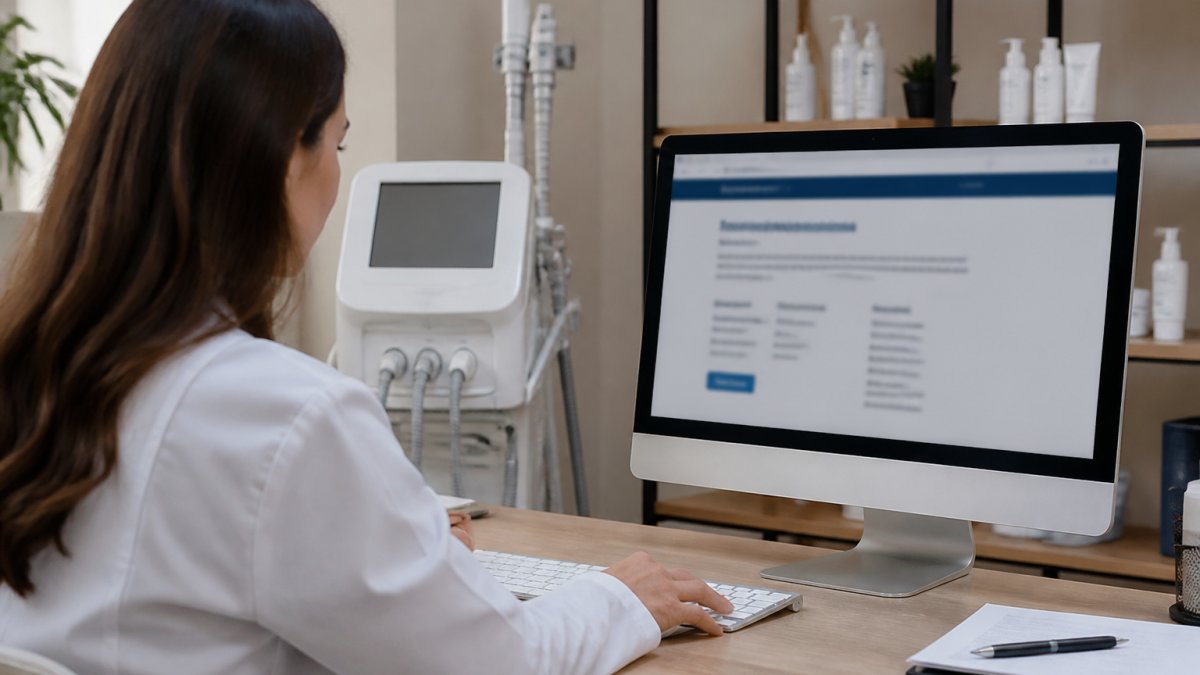
Step 1: Go to the official FDA database
Navigate to the FDA's Device Registration and Listing portal at fda.gov. This is the only authoritative source.
Step 2: Choose your search method
Search by device name or product code
Enter the device name as the supplier lists it. The FDA product code is a three-letter code that categorizes the device type (for example, "OHD" for aesthetic laser devices). Results show the device classification, intended use, and regulatory pathway.
Search by manufacturer or establishment name
Enter the company name as it appears on their official documentation. Results list all registered facilities and their establishment registration numbers. Check that the address matches the supplier's claims.
Search by registration or certificate number
Enter the number exactly as provided. The database returns the specific registration or clearance record. This is the most direct verification method.
Interpreting Search Results and Understanding Record Status
Key information to verify:
Registration status shows whether the establishment is currently registered.
Device classification tells you the risk level (Class I, II, or III).
Regulatory pathway shows whether the device received 510(k) clearance or PMA approval.
Intended use describes what the device is approved to do. Verify this matches your planned use.
Clearance or approval date shows when the FDA made its decision.
CO2 Fractional Skin Care Laser Machine, FDA Registered →
What to Do When Equipment Is Not Found in FDA Records
A search that returns no results requires systematic investigation to determine why the device is not appearing and whether it can be legally purchased.
Step 1: Verify the exact information from your supplier
Database searches are literal. A single misspelling or variation in company name will return no results.
Ask your supplier for:
- The exact device name as it appears on the FDA clearance or approval letter.
- The manufacturer's legal name as registered with the FDA.
- The FDA establishment registration number.
Try multiple search variations:
- Search by the legal manufacturer name, not the brand name.
- Search by partial name if the full name is very long.
- Search by product code if you have it.
- Search by the establishment registration number.
If the device appears under any of these searches, proceed to interpreting the record.
Step 2: Determine whether the device is legitimately exempt or predates modern FDA requirements
Some equipment may not appear in current FDA databases for legitimate reasons:
Grandfathered devices: Devices legally marketed before May 28, 1976 may be exempt from certain FDA requirements but must still be registered (the FDA). Ask for FDA correspondence confirming the exemption.
Class I devices: Low-risk aesthetic devices may be Class I and not require 510(k) clearance, but must still be registered in the DRL system.
Devices marketed before 2010: Older devices may have been cleared under legacy systems. Ask for a copy of the original FDA clearance or approval letter, the product code, establishment registration number, and proof of continuous registration.
Legitimate manufacturers will provide this paperwork. If they refuse, do not proceed.
Step 3: Contact the FDA directly
If you cannot find the device and the supplier cannot provide clear documentation, contact the FDA.
FDA device registration inquiries:
- Call 1-888-SAFEBIZ (1-888-723-3249).
- Submit a question at fda.gov/about-fda/contact-fda.
- Email CDRH-Inquiries@fda.hhs.gov.
Provide the device name, manufacturer name, intended use, and any registration or clearance numbers. The FDA will confirm regulatory status in 10-15 minutes.
Step 4: Assess supplier credibility and documentation
If the device is not found and the supplier cannot provide FDA documentation, evaluate the risk:
Red flags:
- The supplier cannot provide an establishment registration number or 510(k) clearance number.
- The supplier refuses to share the FDA clearance or approval letter.
- The supplier provides a document with no official FDA letterhead, seal, or reference number.
- The supplier becomes defensive when asked for regulatory documentation.
Green flags:
- The supplier provides a copy of the FDA clearance or approval letter with an official FDA reference number.
- The supplier can explain the device's classification and regulatory pathway in technical terms.
- The supplier provides the establishment registration number for independent verification.
- The supplier acknowledges limitations in the device's approved use.
Step 5: Decide whether to proceed
Do not purchase if:
- The device does not appear in any FDA database.
- The supplier cannot provide a clearance or approval number.
- The supplier cannot provide documentation of FDA correspondence or approval.
- The supplier becomes evasive or refuses to answer regulatory questions.
The liability and safety risk to your practice is not worth the cost savings. Unregistered or uncleared equipment can result in client injury, regulatory fines, and loss of your professional license.
Proceed with caution if:
- The device is very old (pre-2000) and the supplier can provide original FDA documentation but the device no longer appears in current online databases. Request a letter from the FDA confirming the device's registration status.
- The device is legitimately Class I and the supplier can provide registration documentation, even if clearance was not required.
Proceed confidently if:
- The device appears in the FDA DRL system with active registration.
- The device has a 510(k) clearance number or PMA approval number that you can verify in the official FDA database.
- The supplier provides a copy of the FDA clearance or approval letter.
- The intended use on the FDA record matches how you plan to use the device in your practice.
Questions to Ask Your Supplier About FDA Registration
Before you commit to any equipment purchase, ask these specific questions.
"Can you provide your establishment registration number?" Legitimate manufacturers know this immediately.
"What is the FDA product code for this device?" This three-letter code identifies the device category.
"Has this device received FDA 510(k) clearance or PMA approval?" This is the critical question.
"What is the intended use according to FDA labeling?" Compare this to how you plan to use the device.
If your current supplier cannot answer these questions clearly, that's a signal to look elsewhere. As you expand your practice with new equipment and modalities, consider pairing your purchases with professional education. Online Service Training for Estheticians can help you and your team master new devices and techniques, ensuring you're using verified equipment safely and effectively.
Frequently Asked Questions
How do I check if equipment is FDA registered?
Visit the official FDA device database portal and search by device name, manufacturer name, or registration number. The database shows whether an establishment is registered and whether specific devices are listed with the FDA. You can verify current registration status directly through this portal, which is updated regularly. Always use the official FDA source rather than relying on supplier claims alone.
What is the difference between FDA registered and FDA approved?
FDA registered means a manufacturer has listed their establishment and devices with the FDA, confirming they meet basic regulatory requirements. FDA approved means the device has undergone rigorous clinical testing and been cleared by the FDA for specific uses. Not all registered devices are approved; approval requires additional evidence of safety and effectiveness. When evaluating equipment, understand which status applies to your intended use.
What information do I need to verify a device in the FDA database?
You can search using the device name, manufacturer name, product code, registration number, or establishment name. The more specific information you provide, the easier verification becomes. If you have the registration or listing number from documentation, that's the quickest way to confirm status. Manufacturer information is also reliable if the company name is exact.
What should I do if FDA registered equipment doesn't appear in the database?
First, verify you're using the correct official FDA portal and that spelling and company names are accurate. Contact the supplier directly and ask for the specific registration number or establishment name. If the equipment still doesn't appear, the device may not be registered as claimed. Request documentation from the supplier showing FDA registration details before making a purchase decision.
Verifying FDA registered equipment protects your practice from liability, client safety issues, and wasted investment. The process takes minutes and gives you certainty. When you're ready to invest in professional-grade aesthetic equipment, choose a supplier like SkinAct that provides full FDA documentation and stands behind every product. Our commitment to regulatory compliance and equipment durability means you get tools you can trust for years of reliable performance.