Why Spa Workflow Efficiency Matters for Your Business
Quick Summary
Spa workflow efficiency is the degree to which a spa moves a client from booking to checkout with minimal wasted time, duplicated work, and idle staff or rooms. It matters because small gaps, such as late setups or missing forms, repeat every day and compound across a week and a year. Efficient workflow protects treatment time, so estheticians spend more hours on client-facing work.
- Calendar slots must include treatment, room reset, and consultation time, not just the hands-on minutes.
- Tag each service with the providers qualified to deliver it to avoid last-minute swaps.
- Automated reminders sent 48 and 24 hours before appointments give clients a chance to reschedule.
- Track room utilization, no-show rate, turnaround, on-time start rate, and revenue per room.
- Start with one bottleneck, change one thing, and measure the result for two to four weeks.
Table of Contents
- What Spa Workflow Efficiency Means in Practice
- How Scheduling and Appointment Management Drive Daily Output
- Setting Up Treatment Rooms to Cut Idle Time
- Where Medical Spa Workflow Automation Saves Time
- Training Staff to Keep Procedures Consistent
- Measuring Efficiency and Finding Workflow Bottlenecks
- Planning Your Next Workflow Improvement Step
- Frequently Asked Questions
Why Spa Workflow Efficiency Matters for Your Business
Last Updated: November 8, 2026
What Spa Workflow Efficiency Means in Practice
Spa workflow efficiency is the degree to which a spa moves a client from booking to checkout with minimal wasted time, duplicated work, and idle staff or rooms. It is the operational backbone behind every good treatment: the room is ready when the client arrives, the intake is complete, and the esthetician spends her hours on the face rather than on paperwork.
Efficiency is not the same as rushing. A spa that squeezes in extra clients by cutting consultation time usually loses more in rebooks and complaints than it gains in volume. The goal is fewer interruptions, fewer handoffs that fail, and fewer minutes lost between services.
A useful working definition is the share of available treatment time that is spent on billable, client-facing work. Gaps from late setups, missing forms, double-booked rooms, and unclear staff assignments all reduce that share. Because these gaps repeat every day, small losses compound quickly across a week and a year.
How Scheduling and Appointment Management Drive Daily Output
Scheduling is where workflow problems start and where they are easiest to fix, because the calendar is the one place where every constraint, treatment length, room cleaning, provider skill, and client preference, either gets respected or gets ignored.
The core mechanism is buffer math. Every service has three durations: the hands-on treatment time, the room reset time, and the consultation or intake time.
Skill-based routing matters just as much. When a team needs to close a skill gap rather than work around it, Online Service Training for Estheticians gives staff a structured way to add services to their skill set.
No-shows and gaps are a separate problem with a separate fix. A waitlist that automatically offers released slots to clients who have opted in fills cancellations without staff phone calls. Deposits or card-on-file policies reduce late cancellations, though they need to be explained clearly at booking to avoid friction.
Room and resource allocation is the third lever. Some services need a wet room, a steam unit, or a specific device, and those resources become the real bottleneck even when providers are free.
Many spas find that a short review of two or three weeks of booking data reveals predictable patterns, such as peak times on weekends or consistent gaps on Tuesday afternoons. Adjusting slot lengths, buffer times, and waitlist rules to match those patterns is a low-cost change that often improves daily output without adding staff.
Shortening buffers to squeeze in one more appointment can backfire, because a room that falls behind by mid-afternoon pushes the delay onto every later client.
Setting Up Treatment Rooms to Cut Idle Time
The physical layout of a treatment room affects how quickly a turnover happens. When supplies are scattered, an esthetician loses minutes each time she searches for a clean towel or a specific tool.
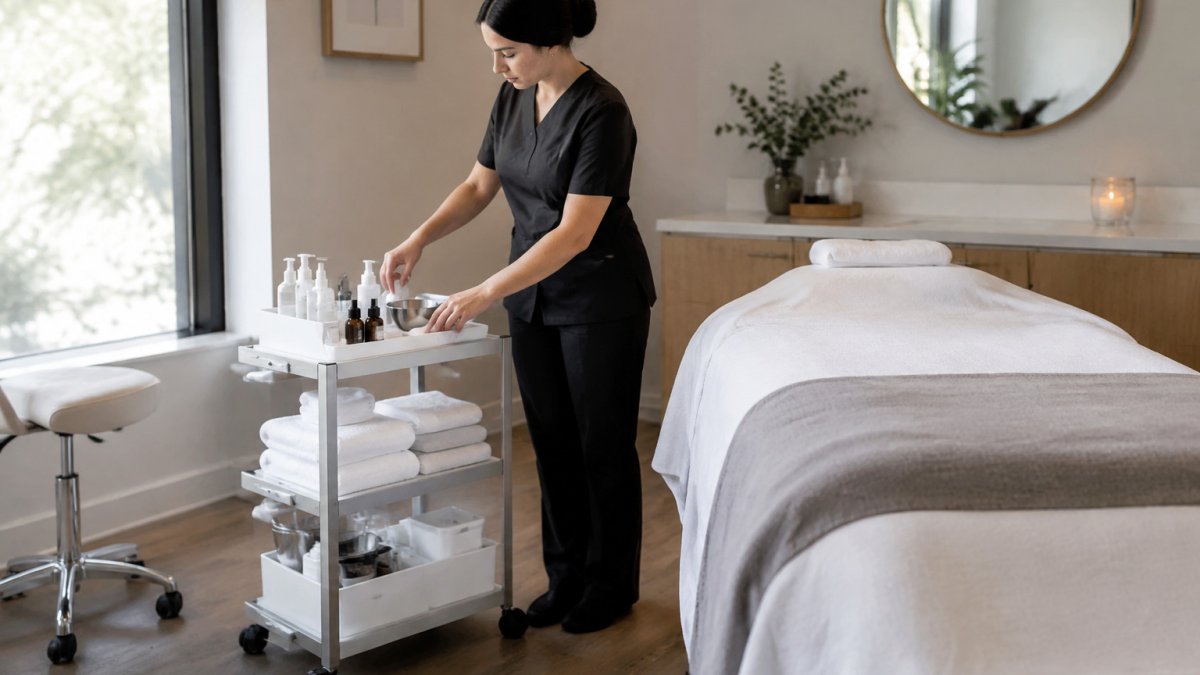
Many practitioners keep a standard restock list posted inside the room, so the next service starts from a known state. The OSHA guidance on workplace organization and housekeeping offers a useful framework for keeping work areas orderly, and the same principles apply to a treatment room.
Storage matters as much as layout. Locking drawers protect tools and products while keeping them accessible, and a towel warmer can keep pre-moistened towels ready so the service does not pause for a fresh set.
Where Medical Spa Workflow Automation Saves Time
Automation earns its place where work is repetitive and rule-based. Digital intake forms, automated appointment reminders, and online consent collection remove manual steps that otherwise happen one client at a time. Each automated step saves a few minutes, but across dozens of clients a week, those minutes add up to a meaningful share of staff time.
Automation should be planned with care. Client health information and consent records carry privacy obligations, so any system that stores them should be evaluated for how it protects that data. The HHS guidance on HIPAA and health information privacy is a useful starting point for understanding the baseline expectations for handling sensitive client data in a medical setting.
Digital intake is also one of the more practical starting points. Clients complete history and skin concern questions before arriving, which frees the consultation to focus on decisions rather than data entry. With intake details captured in advance, the team can also assess where time is being lost across the workflow, using ContinuumPMC as a prompt to examine how each step supports efficient service.
Training Staff to Keep Procedures Consistent
Consistency is what allows a spa to run smoothly when different people work different shifts. When each esthetician follows a slightly different intake process or room reset routine, the result is uneven service and unpredictable turnaround times. Written standard operating procedures give the whole team a shared baseline.
Good procedures are short, specific, and tied to the actual workflow. A room turnover checklist, a standard intake sequence, and a clear rule for who handles checkout are more useful than a long manual nobody reads. Training should walk new staff through each step in the room, not only in a classroom.
For estheticians who want to build these standards into their own practice, Client Intake and Skin Analysis Forms bundle offers ready-made intake and skin analysis templates that teams can use the same way every time. Online training can also help staff build consistent consultation habits; our Client Intake Mastery course for estheticians covers how to turn intake information into treatment decisions.

Measuring Efficiency and Finding Workflow Bottlenecks
Most spas talk about efficiency in feelings, the day felt chaotic, the rooms felt behind, but a feeling cannot tell you whether last month's change helped. The practical fix is a small measurement framework with a baseline, a target, and a review cadence.
Start with a definition you can actually compute. A workable one is billable treatment minutes divided by total available treatment-room minutes for the same period.
A baseline set of five indicators covers most of what matters:
- Room utilization: billable treatment minutes divided by available room minutes.
- No-show and late-cancellation rate: missed appointments divided by total booked appointments, tracked separately because they need different fixes.
- Appointment turnaround: minutes from one client's checkout to the next client's service start in the same room.
- On-time start rate: share of appointments that begin within a defined grace window, such as five minutes.
- Revenue per available treatment room (RevPATOR): total service revenue divided by available room hours, which lets you compare a slow Tuesday against a busy Saturday on the same scale.
Pull two to four weeks of historical booking and checkout data to set the baseline before changing anything. Then set targets that are modest and specific, for example, cutting average turnaround by five minutes or lifting on-time starts by ten percentage points, rather than aspirational. Review weekly for the first month, then monthly once the pattern holds.
To find where the losses actually occur, walk the full client journey once and time each stage: discovery and booking, intake and consent, check-in, consultation, treatment, checkout, and follow-up. Note every point where a client waits, a staff member searches, or a task is repeated.
Estimating the return is straightforward once you have the baseline. Multiply the minutes saved per appointment by appointments per week to get weekly labor minutes recovered, then convert that to staff hours. Add the revenue from appointments that fill previously empty slots.
Watch out: tracking too many indicators at once usually produces a dashboard nobody reads, pick the five that map to your bottleneck and ignore the rest until the first set is stable.
The article names five indicators that cover most of what matters when measuring spa workflow efficiency.
| Indicator | How it is measured | Why it matters |
|---|---|---|
| Room utilization | Billable treatment minutes divided by available room minutes | Shows how much open room time is actually used |
| No-show and late-cancellation rate | Missed appointments divided by total booked appointments | Tracked separately because each needs a different fix |
| Appointment turnaround | Minutes from one client's checkout to the next client's service start | Reveals idle time between services in the same room |
| On-time start rate | Share of appointments starting within a defined grace window | Measures schedule reliability, such as a five-minute window |
| Revenue per available treatment room | Total service revenue divided by available room hours | Compares a slow Tuesday against a busy Saturday on one scale |
Planning Your Next Workflow Improvement Step
Start with one bottleneck, not a complete overhaul. Choose the step that costs the most time or causes the most client frustration, change one thing about it, and measure the result for two to four weeks. Small, tested changes are easier for staff to adopt and easier to evaluate than a sweeping redesign.
Document what you change so the team knows what the new standard is. Then move to the next bottleneck. Over several months, these incremental gains add up to a spa that runs with fewer gaps, more predictable days, and more time spent on the treatments clients came for.
Frequently Asked Questions
What is workflow efficiency?
Workflow efficiency is how well a spa turns its inputs, such as staff hours, treatment rooms and booking capacity, into completed services with minimal wasted time. In practice it shows up as fewer gaps between appointments, shorter waits for clients, less manual data entry and rooms that are ready when the next client arrives. A spa with strong workflow efficiency can serve more clients without adding staff or space, and staff spend more of their shifts on treatments rather than administrative tasks.
Why is workflow efficiency important in a spa?
Spa revenue depends on how many billable treatment hours you deliver, so every idle room, unfilled appointment slot and double-handled task reduces income. Efficient workflows lower the no-show and cancellation impact, keep staff labor costs aligned with bookings and make the client experience smoother. Efficiency also protects the time estheticians need for consultations and documentation, which supports consistent results and better retention.
What are the benefits of workflow automation?
Automation handles repetitive tasks such as appointment reminders, digital intake forms, consent collection and follow-up messages. Staff spend less time on phone tasks and paperwork, clients receive consistent communication, and records stay complete and easy to find. Automation works best when you first document your current procedures, so you automate a process that already works rather than an unclear one.
How can spa owners identify workflow bottlenecks?
Walk through a typical client visit from first booking to rebooking and note every handoff, wait and manual step. Look for patterns such as rooms sitting empty between appointments, clients waiting at check-in, or forms completed on paper and re-entered later. Track a few simple measures over several weeks, including no-show rate, idle room time and average time from arrival to treatment start, then focus on the stage where delays repeat most often.
Which spa tasks can be automated?
Common candidates include appointment confirmations and reminders, online booking, digital intake and consent forms, payment reminders and post-treatment aftercare emails. Scheduling tools can also flag gaps and suggest rebooking. Tasks that require clinical judgment, such as skin analysis and treatment selection, should stay with a trained professional, with automation supporting the documentation around them.
What role does staff training play in spa workflow efficiency?
Written procedures only improve efficiency if staff follow them consistently. Training covers how to run check-in, prepare a room, document a consultation and hand off a client between team members. Standard operating procedures reduce errors and the time spent correcting them, and they make it easier to onboard new staff. Revisit procedures periodically and update them when a process changes.
How does an efficient spa workflow improve the client experience?
Clients notice when they are kept waiting, when the room is not ready or when they must repeat information they already gave. An efficient workflow means clear booking confirmations, forms completed before arrival, on-time starts and consistent aftercare notes. These details build trust and make it more likely that clients return and book additional services.