How to Add Drip Therapy Chairs to Your Med Spa
Last Updated: November 10, 2026
Quick Summary
Adding drip therapy chairs to your medical spa gives clients a comfortable, adjustable seat for longer infusions, which supports repeat visits. Choose the chair type that matches your service menu, whether a dedicated IV recliner for drip lounges or a powered treatment chair for mixed procedures. Measure your room first, since a chair that looks right may not fit your treatment space.
- A comfortable, adjustable chair lets clients relax during longer infusions, which supports repeat visits.
- A well-built chair with cleanable upholstery reduces wear and simplifies daily turnover between patients.
- Dedicated IV recliners like the Vento and Lusso are each priced at $999.00 for drip-focused lounges.
- Measure the footprint, including the recline arc and staff clearance, before ordering any chair.
- Confirm delivery paths and doorway widths, since a chair that fits the room may not fit through the door.
Table of Contents
- Why Drip Therapy Chairs Matter for a Medical Spa
- How to Choose an IV Therapy Chair for Your Practice
- IV Therapy Chair Features That Affect Patient Comfort
- Matching Chair Choice to Your Spa Workflow
- Planning a Medical Spa IV Therapy Room Design
- Keeping IV Therapy Chairs Clean and in Service
- Booking Your First Drip Therapy Chair Order
- Frequently Asked Questions
Why Drip Therapy Chairs Matter for a Medical Spa
Drip therapy chairs are reclining seats built for patients receiving IV infusions, such as hydration, vitamin, and nutrient drips. For a medical spa, the chair is the main piece of furniture in the treatment area, so its comfort and reliability shape both patient experience and how many sessions your team can run in a day. This guide covers what to look for before you buy.
The benefits of adding drip therapy chairs to your medical spa are practical. A comfortable, adjustable chair lets clients relax during longer infusions, which supports repeat visits. A well-built chair with cleanable upholstery also reduces wear and simplifies daily turnover between patients.
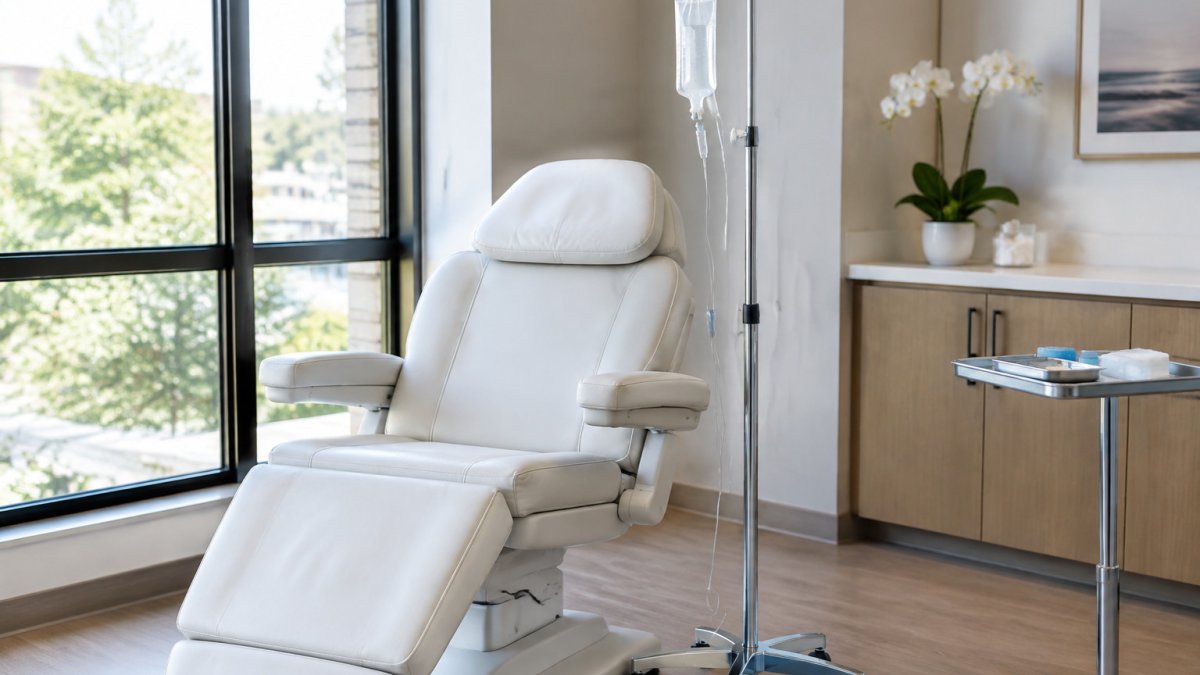
Before buying, it helps to understand the core equipment categories. Recliner-style IV chairs are designed specifically for drip lounges. Electric treatment tables and chairs serve a wider range of procedures and can double as facial or treatment furniture. Choosing the right type depends on what you plan to offer.
| Chair Type | Typical Use | Best For | SkinAct Example |
|---|---|---|---|
| IV recliner | Hydration and vitamin drips | Dedicated drip lounges | Vento, Lusso |
| Powered treatment chair | Mixed procedures, multi-position care | Medical spas with varied services | Alora, Lucera, Marco |
| Electric treatment table | Full-body and facial work | Spas adding wider service menus | Serene, Malibu |
How to Choose an IV Therapy Chair for Your Practice
Choosing an IV therapy chair starts with your service menu and room layout. A drip-focused lounge needs chairs that recline comfortably and allow easy arm access for IV placement. A broader medical spa may need chairs that also adjust for facial or body procedures.
Start by listing the services you plan to deliver over the next 12 months. Then check the chair's adjustment range, weight capacity, and upholstery against those needs. The Vento IV Chair is priced at $999.00 and is built for drip lounges, with an ergonomic seat and motorized adjustments. The Lusso IV Chair is also priced at $999.00 and comes in four colors, with a one-year warranty, so it suits a practice that wants a finish to match its interior.
For multi-service rooms, the Alora Professional Electric Treatment Chair is priced at $2,599.00 and features four independent motors, dual-sided foot controls, and an ADA-compliant low entry height of 19 inches. The Lucera, at $2,399.00, offers similar four-motor adjustment with side controls and a handheld remote. Compare these against your room size and staff workflow rather than price alone. If your team is also expanding into facial or body services, Online Service Training for Estheticians can help your staff build the skills to use a multi-position chair across more treatments.
Common mistake: buying a chair sized for your showroom rather than your treatment room. Measure the footprint, including the space needed to recline the chair and move around it, before you order.
Price of dedicated and powered treatment chairs
IV Therapy Chair Features That Affect Patient Comfort
Patient comfort depends on a few physical features: how the chair reclines, how it positions the body, how the arms support the client, and how the upholstery handles daily use. These details matter because clients who sit comfortably during longer sessions are more likely to return.
Recline, Positioning, and Arm Access
Look for smooth, quiet motorized recline and independent backrest and leg rest adjustment. Chairs with multiple motors let staff set a position that keeps the client relaxed.
Note that the Venus, Bents, and Malibu models in the SkinAct catalog highlight features such as manually rotatable seats and reversible arms, which can help staff reach the client from different angles.
Upholstery, Cleaning, and Durability
Upholstery is where hygiene and durability meet. The Bellage model specifies high-quality vinyl upholstery that is easy to clean and maintain, and the Malibu and Marco models use super-fiber PU upholstery that is easy to clean.
Check whether the frame is built to handle heavy daily use. The Marco has a full metal base intended for heavy-duty use, which is useful in a high-volume room.
Matching Chair Choice to Your Spa Workflow
The right chair depends on how your team moves through a shift, and the differences show up in throughput, staff strain, and footprint. Chair selection can differ depending on the setup: a solo treatment room, a shared IV lounge, or a high-volume clinic.
Solo Treatment Room
A single-practitioner room usually runs one client at a time, so the chair must multitask. A powered treatment chair with independent backrest and leg rest motors lets the same seat serve a hydration drip in the morning and a facial or body procedure in the afternoon. Look for a low entry height, the Alora's 19-inch ADA-compliant entry is a useful benchmark, because clients step in and out repeatedly. Footprint matters more here than in a lounge: confirm the chair reclines fully without blocking the door swing or the practitioner's path to the sink.
Shared IV Lounge
A lounge with several recliners rewards simpler, dedicated chairs. Staff move between clients to check drip rates, adjust arm positions, and swap bags, so the priority is side access and predictable controls rather than multi-procedure versatility. Dedicated IV recliners like the Vento and Lusso, both listed at $999.00, are a lower-priced option per seat than the powered treatment chairs. Arrange chairs so a single staff member can see and reach each client's IV site without walking behind occupied seats.
High-Volume Clinic
High-volume rooms stress durability and turnover. A full metal base, the Marco uses one for heavy-duty use, and cleanable super-fiber PU upholstery reduce wear between clients. In this model, staff ergonomics become a real cost: repeated bending to adjust manual leg rests or reach low controls adds up over a shift. Chairs with handheld remotes or dual-sided foot controls let staff adjust position without stooping.
Staff Ergonomics and Operational Efficiency
Chair height and access affect setup, monitoring, and strain during repeated treatments. A seat that positions the client's arm at a comfortable working height for IV placement reduces awkward reaching. Dual-sided controls mean a practitioner can adjust the chair from whichever side they are working on. When one staff member monitors several chairs, clear sightlines and accessible controls matter more than premium upholstery.
Watch out: buying a chair sized for your showroom rather than your treatment room. Measure the footprint including the recline arc and the clearance staff need to move around the chair before you order.
A Simple Decision Rule
If your menu is focused on drips, dedicated IV recliners usually offer the best value per seat. If you plan to add facial or body services over time, fewer powered treatment chairs can cover new procedures without another large purchase. Map your expected daily client count against chair count before you commit, a lounge that books six clients in a four-hour window needs different seating than one that books two.
Planning a Medical Spa IV Therapy Room Design
Room design affects both patient experience and staff efficiency, but most guides stop at lighting and outlet placement. The details that separate a workable drip room from a frustrating one are accessibility, clearances, and transfer support, areas largely absent from typical chair-buying advice.
Accessible Clearances and Transfer Support
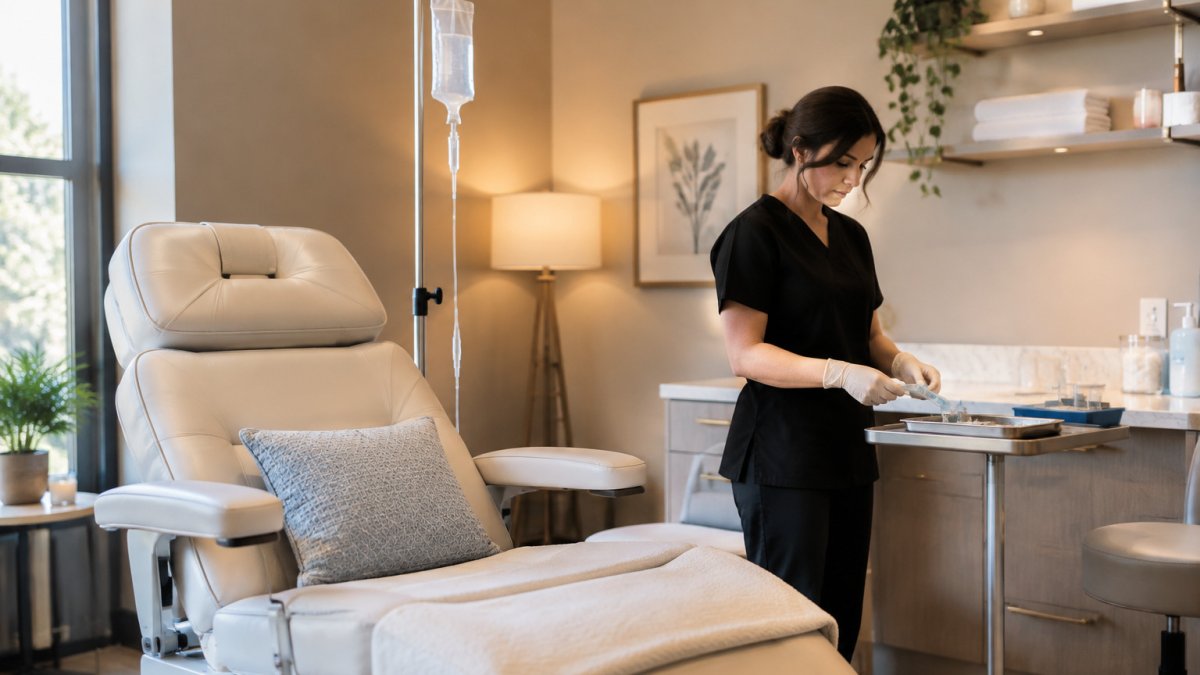
Plan for clients who may need assistance transferring into the chair, and leave enough clear floor space beside each chair for a staff member to stand and help. A low entry height helps clients who can step in with minimal assistance; for others, a chair that reclines flat or near-flat can ease positioning.
Layout and Staff Access
Place supply storage, sanitizing stations, and IV poles within easy reach to avoid unnecessary walking during treatments. Arrange chairs so staff can approach each client from either side; reversible or rotatable arms, as noted on the Venus, Bents, and Malibu models, help here. Keep electrical outlets accessible for chair controls and other equipment, and confirm the chair footprint fits your planned layout before ordering.
Lighting, Atmosphere, and Safety
Warm, adjustable lighting creates a calmer environment, while uncluttered floors reduce trip hazards. Keep cords and IV lines routed away from walking paths. A quiet room supports longer infusions, so consider acoustic separation from high-traffic areas.
Planning for Expansion
Leave room for an additional chair and confirm that your power and floor space can support it. Retrofitting a room later is often more expensive than planning for growth now. Map the expansion path before you finalize the first layout.
Watch out: ordering chairs before measuring doorways and turns on the delivery path. A chair that fits the room may still not fit through the door or around a corner.
Keeping IV Therapy Chairs Clean and in Service
Regular cleaning protects both patients and equipment. Wipe chair surfaces, arms, and controls between every client using a disinfectant appropriate for your upholstery. Check the manufacturer's cleaning instructions for each chair.
Inspect moving parts on a set schedule. Check that motors recline and return smoothly, that controls respond correctly, and that upholstery shows no tears or cracks where bacteria could collect. Address small issues quickly, since a minor fault can become a service interruption.
Keep a simple maintenance log. Note the date of each inspection, any repairs, and the warranty status of each chair. The Lusso listing specifies a one-year warranty, and tracking warranty status helps you act quickly if a problem appears within the coverage period.
Booking Your First Drip Therapy Chair Order
When you are ready to order, start by confirming three things: the chair type that matches your service menu, the room measurements, and your budget. Request quotes for two or three models so you can compare features and warranty terms side by side.
Ask the supplier about delivery timelines, installation support, and what the warranty covers. For a multi-location plan, confirm the supplier can provide consistent equipment across sites.
You can contact SkinAct to request a quote or ask questions about which chair fits your room before you buy. For a broader view of planning your purchase, see how to choose medical spa equipment, and for budgeting your full outfitting cost, read the medical spa budget guide. If you are ready to compare specific models, start with the Vento IV Chair or the Lusso IV Chair.


Frequently Asked Questions
How many IV therapy chairs does a medical spa need?
The right number depends on your average appointment length, your opening hours, and how many clients you expect at peak times. A practice that books mostly short hydration sessions may run more chairs with a shorter turnover than a clinic offering longer infusions. Start by estimating your busiest hour, multiply by the time each treatment takes, and plan for one chair per concurrent client. Add a spare chair if downtime would stall your schedule. Chairs like the Vento and Lusso, both listed at $999.00, are one option for a practice adding capacity in steps.
What features matter most in a medical spa infusion chair?
Focus on positioning range, arm access for IV placement, upholstery that wipes clean quickly, and a stable base that supports the client's full weight. Electric chairs with programmable memory settings let staff return to a preferred position without repeated adjustments. Compare these specifications directly on each product page before committing to a model.
How should IV therapy chairs be cleaned and maintained?
Wipe down upholstery and armrests between every client using a cleaner approved for your surfaces, and follow the manufacturer's instructions for disinfectants. Check motors, controls, and cords on a regular schedule so small faults are caught early. Keep a written log of cleaning and inspections for your staff.